Best Hiking Backpack for Women: How Fit Really Works
The best women's hiking backpack is the one whose torso range holds your measurement and whose hip belt closes with webbing to spare. Here is how to find both numbers.
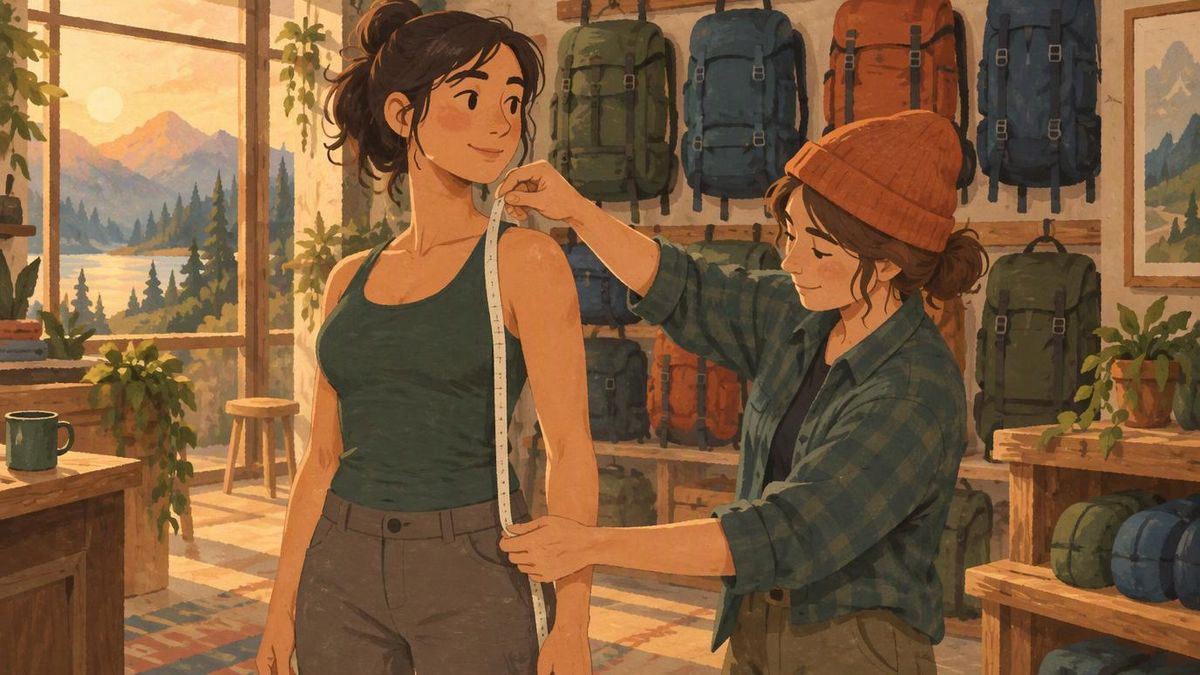
The best hiking backpack for a woman is the one whose torso range includes her torso length and whose hip belt, tightened over a loaded pack, still has 1 to 3 in of webbing between the buckle and the padding. Those two checks matter more than brand, capacity, or any list of features, and they are the two things most “best women’s backpack” roundups never give numbers for. The numbers exist: Osprey’s women’s sizes are WXS/S at 13.5 to 17 in and WM/L at 16 to 19.5 in of torso; Gregory’s Jade XS/S covers 14 to 17 in; Osprey’s Extended Fit belts run 40 to 70 in at the hip. This page explains what a women’s pack changes, how to measure yourself, how capacity maps to trips, and when to leave the standard women’s line for the petite, plus-size or hydration-specific packs covered in their own guides.
What a women’s pack actually changes
Three things, per Osprey’s and Gregory’s own fit notes. The torso range is shorter: women’s sizes start at 13.5 in where men’s S/M starts at 17. The shoulder straps are set closer together at the top and curve outward around the chest instead of running straight down. And the hip belt is shaped and angled for a conical hip, where the difference between waist and hip circumference is larger than on a straight-sided frame, so the padding wraps rather than bridging. A woman with a 17 in torso and narrow hips may be fine in a unisex small; a woman with a 15 in torso, or hips that flare, will not be, and the women’s version of the same pack is the fix.
Measure your torso
Tip your head forward and find the C7 vertebra, the bump at the base of the neck. Put your hands on your hips with thumbs back; the line between your thumbs is the top of your iliac crest. Have someone measure down your spine from the bump to that line. That is your torso length, and it is the only number the size charts care about; two women of the same height can differ by 3 in here. Pick the size whose range contains your number with room on both ends, because adjustable harnesses (Osprey’s cam-lock, Gregory’s VersaFit, Deuter’s VariClick) can move 3.5 to 4 in within a size but cannot go past it.
Measure your hips and check the belt
Measure around your hips at the iliac crest, not at the waist and not at the seat. Standard women’s belts are built for roughly 26 to 48 in there, and adjustable designs like Osprey’s Fit-on-the-Fly add a few inches of padding length. Gregory’s plus guide gives the handoff point: under about 40 in, a standard pack fits more snugly than a plus pack; well above it, the standard belt runs out of padding before it reaches the front of the hip bone. The test when the pack arrives is simple. Load it, tighten the belt with the padding centered on the hip bone, and look at the webbing left between buckle and padding: 1 to 3 in is right, zero means the belt is too small, and 6 or more means it is too big.
Capacity by trip, and why XS holds less
For day hikes, 18 to 25 L; for an overnight or two, 45 to 55 L; for three nights to a week, 60 to 70 L. Then check the volume for your size, not the number in the name. Osprey’s manual lists the Aura AG 65 at 62 L in WXS/S and the Eja 58 at 55 L in WXS/S; the smaller frame is shorter, and the lost liters come out of the main compartment. Load ranges tell you the rest: a 20 L daypack is built for 10 to 20 lb, the Eja for 30 to 35 lb, the Aura for 30 to 40 lb. Carrying over the range is uncomfortable long before it is unsafe.
Packs that publish their fit numbers
Osprey Aura AG 65
The women’s multi-day benchmark: 62 L in WXS/S (13.5 to 17 in torso) and 65 L in WM/L (16 to 19.5 in), 4.71 to 4.81 lb, a 30 to 40 lb load range, an Anti-Gravity mesh back panel, a cam-lock torso adjustment, and the Fit-on-the-Fly hip belt that extends for a precise fit across a range of hips. A 50 L version uses the same harness. Check price on Amazon
Gregory Jade 53
53 L in two women’s sizes, XS/S for a 14 to 17 in torso and S/M for about 16 to 20 in, each with 3.5 in of adjustment. The FreeFloat hip belt pivots with your hips, and Gregory’s 50 lb recommended max is generous for the size. A sensible first overnight pack. Check price on Amazon
Osprey Ariel 65 Extended Fit
The multi-day pack for hips a standard belt cannot reach: Osprey’s EF belt fits 40 to 70 in, with longer shoulder and sternum straps and pockets moved forward on the belt. Same two torso sizes as the rest of Osprey’s women’s line. Check price on Amazon
Osprey Mira 22
The daypack pick when you want water built in: 22 L, 2.77 lb, a one-size women’s harness covering a 14 to 18 in torso with over 4 in of adjustment, and a 2.5 L Hydraulics LT reservoir in the box. Check price on Amazon
When to leave the standard line
If your torso is under 14 in, or you are between sizes at the small end, the petite pack guide covers the XS sizes from Osprey, Gregory and Deuter and the shoulder-strap problems small frames hit. If your hips measure over 48 in at the bone, the plus-size pack guide has the belt ranges for Gregory Plus (to 60 in) and Osprey Extended Fit (to 70 in). If you want the reservoir included rather than sold separately, the water bladder pack guide lists the women’s packs that ship complete. And the pack is only part of the load: the sleep system guides on cold-weather women’s bags, plus-size bags and plus-size pads cover the heaviest things that go inside it, and plus-size hiking pants covers what goes under the belt.
Fitting it at home
Load the pack with 10 to 20 lb. Loosen everything. Belt first, padding centered on the hip bone, tightened until the webbing rule holds. Shoulder straps next, snug but not carrying the weight. Load lifters last, angled up at 30 to 60 degrees; flat lifters mean the torso is set too long, lifters pointing nearly straight up mean too short. Walk around for ten minutes, including stairs. If the belt rides up, the sternum strap bottoms out, or the straps gap over your shoulders, the pack is the wrong size, not badly adjusted, and it should go back.