Camping With a Baby Checklist: What to Pack, by Age
What to bring camping with a baby under two, with counts per day, what changes from 0 to 6 months to toddler, and the common list items that should stay home.
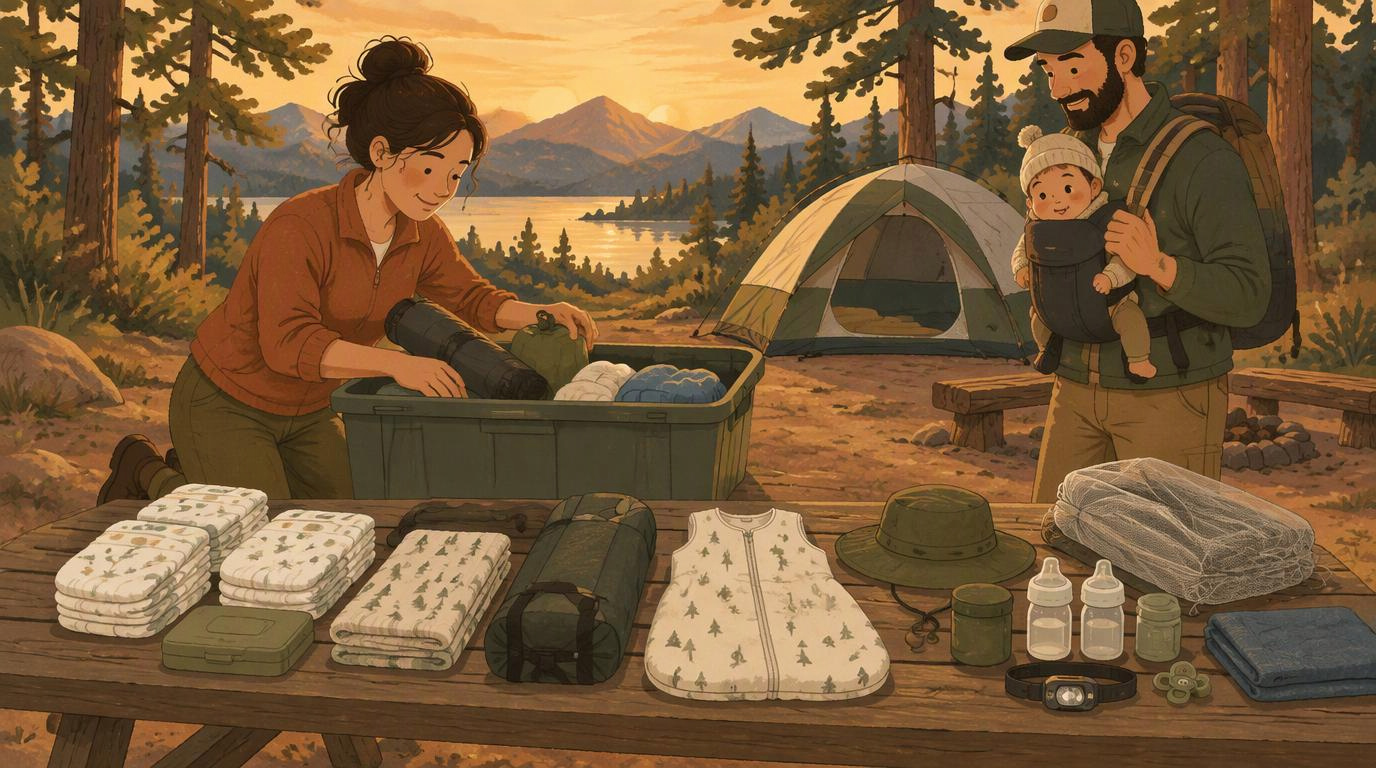
For a baby under two, a camping checklist comes down to five groups: a safe place to sleep (a travel crib on a foam pad, a wearable sleep bag rated for the forecast low, nothing loose), one more layer than you would wear, feeding and diapering supplies counted by the day plus one spare day, shade and cover-up clothing for sun and bugs, and the small kit you need within reach at 3 a.m. What changes the list is the baby’s age and the forecast low. Each link below goes to the page on this site that picks the product.
The list at a glance
This is the baby’s bin, not the family’s. Mark each line “have” or “need”; the “need” column is the shopping list.
Sleep: travel crib or play yard that meets the CPSC standard, with its own mattress and fitted sheet (which cribs fit a tent floor, and where the parents’ pads go, is in camping with a baby: where do they sleep); closed-cell foam pad under the whole crib, never inside it; two wearable sleep bags rated for the overnight low, worn over a base layer and fleece pajamas with nothing over the bag (the plan by temperature is in camping with a baby in cold weather); breathable blackout cover made for the crib, not a towel; white-noise device if you use one at home; red-mode headlamp.
Clothing: two outfits per day under 12 months, one plus a spare for toddlers; wool or synthetic base layer and fleece pajamas for nights; a sun hat with a 3-inch all-around brim and a warm hat; long sleeves and long pants for sun and bugs; socks or booties; a rain layer; a sealable bag for wet clothes.
Feeding: bottles for a full day’s feeds, or three bottles and a wash kit; formula measured per feed into a dispenser, plus a spare day; a sealed jug of safe water, and a pot to boil it if your baby needs that; bibs; for a baby on solids, pouches and finger foods with a spare day, a spoon and a chair or booster with a tray.
Diapering: your baby’s daily count times nights, plus one full extra day; one pack of wipes per two days; diaper cream; a folding changing mat; an odor-proof bag for used diapers, which go home or to the campground bin and, in bear country, into the bear box.
Health: digital thermometer; nasal aspirator and saline; the family first aid kit; any medicine your pediatrician has told you to carry, with the weight-based dose written down; hand sanitizer; a small towel.
Sun and bugs: shade (a tarp, the vestibule or a stroller canopy); mosquito nets sized to the crib and to the carrier or stroller; sunscreen for a baby over 6 months; a repellent checked against the label’s age limit.
Carrying and playing: a soft carrier, or a framed carrier once the baby sits unassisted; a play mat; two or three washable toys and a book.
How many: diapers, outfits, bottles, sleep bags
The counts above are rules of thumb from what families report using; your own baby’s numbers win.
Diapers: the one published figure is 7 to 13 a day depending on the baby. Three nights at 9 a day is 27 plus a spare day, so 36; the extra day covers the drive home and the blowout you did not plan for.
Wipes: a pack per two days, because wipes also clean hands, bibs, the mat and the picnic table.
Outfits: two a day under 12 months, since blowouts and dew both take a set and there is no dryer. Toddlers get one plus a spare; pants get rinsed, not replaced.
Sleep bags: two, so a leaking diaper does not end the trip at 2 a.m.
Bottles: with hot water and a basin, three bottles plus brush, soap and a drying mesh. If washing will be hard, one bottle per feed, washed in one batch.
What changes with age: 0 to 6 months, 6 to 12, 12 to 24
The essentials shift at three points.
Under 6 months: the travel crib is the sleep surface from the first night, with a foam pad under it and a bag rated for the low. Shade and covering clothes do the sun work and netting does the bug work; the AAP thresholds are below. The baby rides in a soft carrier; no chair, no framed pack. Milk only, and the CDC’s boil-the-water rule applies under 2 months. Layers and the cold plan are in camping with a baby in cold weather.
6 to 12 months: solids arrive, with a bib, a spoon, pouches and a place to sit; the harness and weight-limit rules are in camping chair for a toddler with a tray. Once the baby sits unassisted, a framed carrier replaces the soft one; which carriers fit the child and the adult is in hiking backpack for a toddler. Sunscreen can now go on all exposed skin, repellent is allowed within the label’s age limit, and a net goes over the crib once the baby wakes and reaches in the morning.
12 to 24 months: walking shoes and a second pair of socks, because they will go in the lake. The baby sleep bag gives way to a toddler one with sleeves and no hood, a different product from a child’s sleeping bag; see sleeping bags for kids in cold weather. The fire pit becomes the main hazard. A cot is not a sleep surface for a baby; for a toddler out of the crib it works only on the conditions in best camping cot for kids, mesh walls on all four sides, or a pad on the floor instead.
Leave at home, and why the list says “nothing loose”
Sleep is the group that goes wrong in a tent, because cold tempts parents to add things. The AAP safe sleep recommendations apply to every sleep under 1 year: back to sleep, on a firm flat surface in a crib or play yard that meets CPSC standards, a fitted sheet and nothing else in it, one layer more than an adult would wear, no bed-sharing. That rule is why the first four items below stay home; the rest turn up on blog checklists and should stay home too.
Pillows, blankets, quilts, comforters, and a mattress topper or second mattress: all named by the AAP as soft objects and loose bedding to keep out of the sleep space. The crib’s own mattress and a fitted sheet are the whole surface; the foam pad under the crib is how it stays warm without a topper.
An air mattress for the baby: the AAP requires a firm, flat surface, and an inflatable is neither.
A weighted sleep sack or swaddle: the AAP says not to use weighted sleepers, swaddles or blankets. A regular swaddle stops at the first attempt to roll, usually around 3 to 4 months. No hat for sleep either: the AAP says no hat indoors after leaving the hospital, because of overheating.
The car seat or stroller as a bed: the AAP says a baby who falls asleep in one is moved to a firm, flat surface as soon as possible.
A combined sunscreen and repellent product: on the AAP’s “don’t use” list, because it can expose the child to too much repellent. Likewise any oil of lemon eucalyptus or PMD repellent for a child under 3; the AAP and the CDC both say so.
A fuel-burning heater, stove or lantern inside the tent: carbon monoxide in a small space. The cold-weather page covers what is safe.
A bottle maker, a baby gate and a laptop: they need an outlet, a doorway and a dry room.
Sun, bugs and water: the age rules in one place
These thresholds are the AAP’s and the CDC’s, from the pages in the sources; a pediatrician who knows your child overrides any of them.
Sun (AAP): babies younger than 6 months stay out of direct sunlight, under shade, in cool clothing that covers the body, with a hat that has an all-around 3-inch brim. Sunscreen under 6 months goes only on small areas such as the face, and only if clothing and shade are not available. Over 6 months, a broad-spectrum sunscreen of at least SPF 15 on all exposed skin, careful around the eyes, reapplied every 2 hours and after swimming, sweating or towelling off.
Bugs (AAP and CDC): netting over the carrier and stroller, and clothing that covers arms and legs. No oil of lemon eucalyptus or PMD under 3. Neither the AAP’s repellent page nor the CDC’s mosquito pages state a minimum age for DEET or picaridin, and the EPA registers DEET with no age restriction, so follow the age limit on the label and, as the AAP puts it, be especially cautious with newborns and premature infants. The AAP’s figures: 30% DEET protects for about 5 hours, over 50% adds nothing, 20% picaridin covers 8 to 12 hours. Never on a child’s hands, eyes, mouth, cuts or irritated skin; spray your own hands and rub it on the child’s face; wash it off with soap and water at the end of the day.
Water and formula (CDC): mix with water from a safe source, which at a campground means the sealed jug you brought or a tap the campground states is potable, not a stream. For a baby under 2 months, born prematurely or with a weakened immune system, boil the water and wait about five minutes before mixing, then cool the bottle. Prepared formula is used within 2 hours of mixing and within 1 hour of the start of a feed, or refrigerated and used within 24 hours; leftovers are thrown out. An opened container of powder is usually good for a month; check the label before packing a half-used one.
The 3 a.m. kit and the first trip
Everything you will need in the dark goes in one small dry bag inside the tent, within reach of your pad: six diapers, wipes, a change of clothes, the spare sleep bag, a burp cloth, the pacifier and a spare, water for you, the headlamp on red. The bin stays in the car, dry and out of reach of raccoons.
Make the first trip one night within an hour of home. The week before, put the baby down for a nap in the travel crib at home so the first time in it is not a dark tent. Pack the bin two days early, and tape a day-of list to the door for what cannot go in early: pumped milk, the cold items, the current pacifier. If the night goes wrong, the fix is the car’s heater and the drive home, which is the reason to camp close.
When to ask the pediatrician first
This list follows the AAP and CDC guidance in the sources; it is not medical advice and does not replace a doctor who knows your child. Talk to your pediatrician before the trip if the baby was born preterm, is under about 3 months, has any breathing or temperature-regulation concern, or if the forecast low is near freezing. Any medicine you carry, fever reducers and antihistamines included, goes on the list with the dose for your child’s weight written down by the pediatrician, not taken from a camping blog or this page. For children 3 and up, the by-age kit is in camping gear for kids by age.