How to Keep a Toddler Contained While Camping: What Works
Pop-up pen, panel fence, activity seat or harness: which contains a toddler at each stage, when each stops working, and the campsite fire, water and road rules.
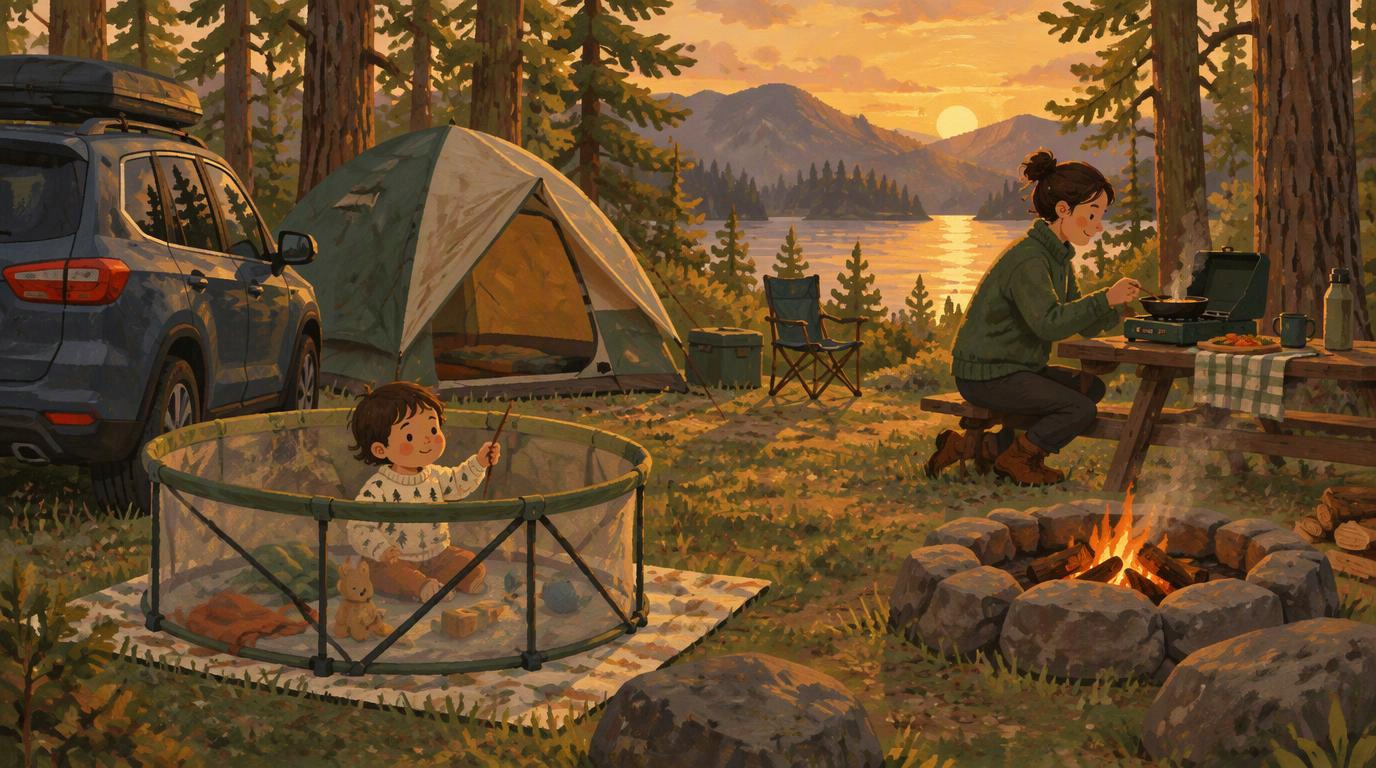
You keep a toddler contained at a campsite the way you do at home: a physical barrier for the short stretches when nobody can watch, and a named adult watching the rest of the time, because “stay near me” does not work on a 2-year-old. Which barrier depends on the child’s stage. A pop-up play yard with a floor works until the child can climb out or reaches 35 inches, the federal play yard limit. A panel fence works for a walker who cannot yet get over a 26 inch wall. An activity seat buys twenty minutes for a baby who sits but does not walk. A harness is for the walker on the move. Pick the site first, because a site away from water and the loop road does more than any pen.
Containment is for twenty minutes at a time, not the day
There are four or five windows in a camping day when both adults have their hands full: pitching the tent, lighting the fire, cooking and washing up, packing out. Each runs fifteen to thirty minutes. The rest of the day the system is a person: one adult is on toddler duty and says so out loud, the other does the chores. Trailstead’s rule is a named watcher whenever attention is split, because an unnamed someone watching means nobody is.
Verbal rules do not hold at this age: a 20-month-old agrees to stay by the table and walks toward the fire ring the moment a pan clatters.
Pick the site before the gear
The cheapest containment is a campsite with fewer places to go.
- Not a waterfront site. A lake edge is a full-time job for one adult.
- Not on the loop road or at a junction. Campground roads carry trucks reversing trailers, and a toddler at bumper height is invisible from the cab.
- Back the car in as a wall. Car, picnic table and tent make three sides of a yard with one open edge to watch.
- Face the tent door at the table. A zipped tent with the screen closed is a ten-minute pen with a view.
- Mark a boundary the first afternoon, the tarp edge or a bright cord, so you can see at a glance when they are over it.
The four ways to contain a toddler, by age and stage
Activity seat. A fabric seat on a folding frame with a floor pad, for a child who sits unassisted but is not yet walking. Twenty or thirty minutes with a snack and a toy, one cooking window.
Pop-up play yard with a floor. Mesh sides, a sewn-in floor, folds to a disc. By the CPSC definition this is a play yard, and the federal rule (16 CFR 1221) describes it as for a child who cannot climb out and is under 35 inches. The day a leg goes over the rim it is done, which parent reports put at about 18 to 24 months. For a crawler or new walker it is the best option: up in seconds, with a floor under the child.
Panel fence. Interlocking plastic panels, 26 inches tall, no floor. It encloses 18 to 34 square feet of real play area, or goes around the picnic table. No floor means it stands over roots. It also means it needs level ground and the car or table as one side, or a leaning toddler walks it across the site. It lasts until the child can get over 26 inches or lift a panel, so it outlives the pop-up pen for a strong walker.
Harness. A small backpack with a tether, or a wrist link, for a walker going somewhere. It is the only option that works where a pen cannot go.
At meals the barrier is the harness-and-tray chair in camping chair for a toddler with tray; hiking out of camp, it is a framed child carrier. By 3 the fence comes down and camping gear for kids by age picks up.
Fire, water and roads: the three rules
No barrier replaces an adult watching.
Fire. Put the pen or fence where the National Park Service puts tents and gear: at least 15 feet from the fire ring and upwind. “Not just a few feet back”, as Trailstead puts it, but out of reach even if the child escaped the pen and fell toward the ring. The NPS warns that a young child “might not be cautious about running near it”.
Water. The AAP’s rule for toddlers in or near water is “touch supervision”, an adult within arm’s length, plus a Coast Guard-approved life jacket “when in, on, or near natural bodies of water, such as lakes or rivers”. A pen at a lakeside site is not water supervision.
Roads. The campground loop is a road. A walker on it is on a harness or holding a hand. Healthy Family Living’s jingle bell on the child is a hearing aid for the watcher, not a replacement.
The pen, fence, seat and harness that fit
One product per type. Specs are from the pages in the sources; we have not used them ourselves.
Summer Pop ’n Play Ultimate Playard
The pop-up pen: 14 square feet, 48 inches across, 26 inches tall, about 12 lb, with a water-resistant canvas floor and a canopy that blocks 98 percent of UV; listed for 6 to 24 months. No listing states 16 CFR 1221 certification, so it is the daytime pen, not the night bed. Check price on Amazon
Toddleroo by North States Superyard Indoor/Outdoor 6-Panel
The panel fence: six plastic panels, 26 inches high, 18.5 square feet as a hexagon, with a two-panel extension (sold separately) that takes it to 34.4 square feet; ASTM certified; listed for 6 to 24 months. Check price on Amazon
KidCo GoPod Travel Activity Seat
The activity seat: 7 lb, folds to a 29.5 inch tube, opens to 24 by 24 inches with four seat heights, a floor pad and a snack holder; KidCo lists it for “approximately 4 months to walking” and says it passes the required ASTM standards. Check price on Amazon
Skip Hop Zoo Mini Backpack With Safety Harness
The harness: a 7 by 9 inch backpack whose tether and wrist strap attach at the bottom of the pack, and come off later to leave a plain mini backpack. It is listed for ages 1 to 4, but the fit line says 36 to 42 inches tall, so check the straps on a small 1-year-old. Check price on Amazon
Keeping them busy where you can see them
Entertaining a toddler while camping is the other half of containing one: a child with a job inside the circle stays in the circle, and a bored one tests the fence.
- A bucket, a shovel and the dirt at the tent door.
- A collecting container, Healthy Family Living’s empty yogurt cup or egg carton, for pinecones and rocks. One rule: nothing gets thrown.
- Sticks and rocks, which Parent.com and Big Brave Nomad both report beat every toy from home; bring cheap toys and nothing with batteries.
- Chores as play: carrying kindling, filling the water jug with an adult. “I can do it by myself” is the toddler’s whole vocabulary; use it.
- The loop walk, on the harness or in the wagon, as the afternoon’s outing.
At night: the tent door
Where a toddler sleeps has its own rules; for a child under 1 see camping with a baby: where do they sleep. This section is only the exit question.
The method that transfers from a long-running Outdoors Stack Exchange thread: the adult sleeps across the door and the child at the back, so leaving means climbing over a parent. Never tie, clip or lock the zipper; the top answers both say so, because in an emergency everyone needs out fast. A lantern or glow stick outside the door is a beacon. A floor-type play yard that the maker says meets 16 CFR 1221 can be the night bed; a panel fence cannot.
Can you go camping with a 2-year-old? Yes: book the site away from the water and the loop, bring the one barrier that fits the stage, and name the watcher.